Here is something most trading courses will not tell you upfront.
The market is not a level playing field. On one side, you have retail traders, individuals making decisions on their own, often with limited tools, limited capital, and limited access to information. On the other side, you have institutional traders: hedge funds, investment banks, pension funds, family offices, and proprietary trading desks managing billions of dollars across global markets.
These two groups are not playing the same game. Institutional traders move markets. Retail traders, for the most part, react to them.
But here is the part that changes everything: institutions cannot hide what they are doing. Their activity leaves clear footprints in price and volume data. And retail traders who learn to read those footprints can stop reacting and start positioning alongside the biggest, most sophisticated players in the market.
This guide explains exactly how that works.
Who Are Institutional Traders?

Institutional traders are entities that buy and sell securities in large quantities on behalf of organisations rather than individuals. They include:
Hedge funds: Private investment funds that use a wide range of strategies, including long/short equity, derivatives, and algorithmic trading, to generate returns for their investors. They are among the most active and aggressive participants in global markets.
Investment banks: Large financial institutions that trade on behalf of clients and, in some cases, on their own account. Their trading desks have access to sophisticated tools, real-time data feeds, and direct market access that most retail platforms cannot match.
Pension funds and insurance companies: These are some of the largest holders of equities in the world. Their investment decisions tend to be longer-term, but when they rotate capital between sectors or asset classes, it creates significant market movement.
Family offices: Private wealth management firms managing the assets of ultra-high-net-worth individuals and families. Sophisticated family offices often operate with hedge fund-level capabilities.
Mutual funds and ETFs: Pooled investment vehicles that accumulate capital from thousands of individual investors and deploy it at scale. When a major index fund rebalances, the resulting trades can shift prices across entire sectors.
Together, institutional traders account for the majority of daily trading volume in most major markets. In the US equity
Why Institutional Size Changes Everything
The most important thing to understand about institutional traders is that their size fundamentally changes how they have to operate.
When a retail trader wants to buy 500 shares of a stock, the trade is executed almost instantly at or near the market price. The purchase is too small to move anything.
When a hedge fund wants to build a position of 10 million shares in the same stock, the situation is completely different. If they placed a single market order for 10 million shares, their own buying pressure would push the price up sharply before the order was even half filled. They would end up paying significantly more than the price when they started, simply because of the scale of their own demand.
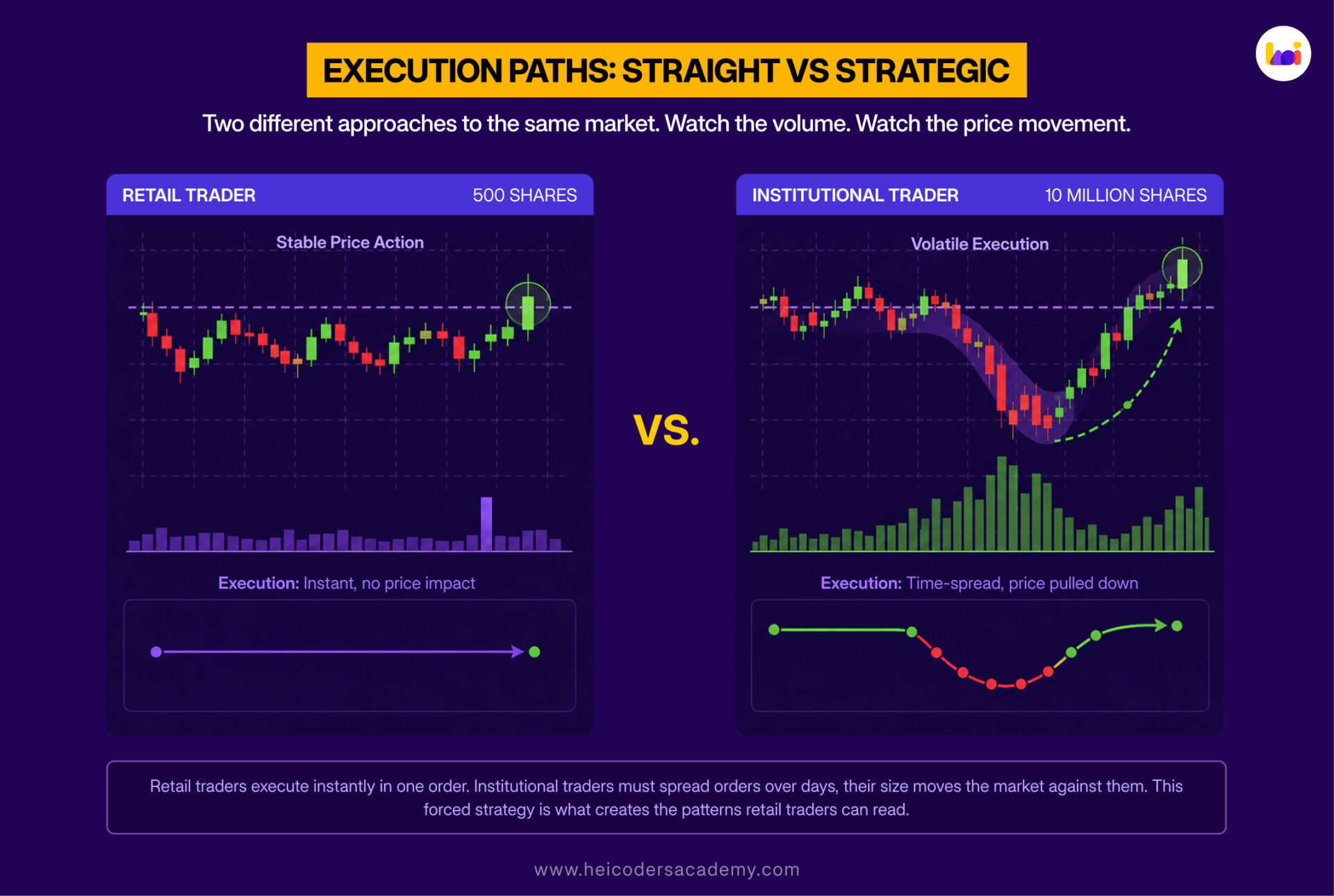
This is known as market impact, and it is one of the central challenges of institutional trading. To manage it, institutions have to be strategic about how, when, and at what price they accumulate or exit their positions. They spread their orders over time. They use algorithms to disguise their activity. They take advantage of high-volume periods to execute large trades without creating obvious price distortions.
Understanding this one concept, that institutions cannot buy or sell everything at once, is the foundation of everything else in this guide.
The Accumulation Phase: Where the Big Money Builds Its Position
When an institutional trader wants to build a large long position in a stock, they go through what is known as an accumulation phase.
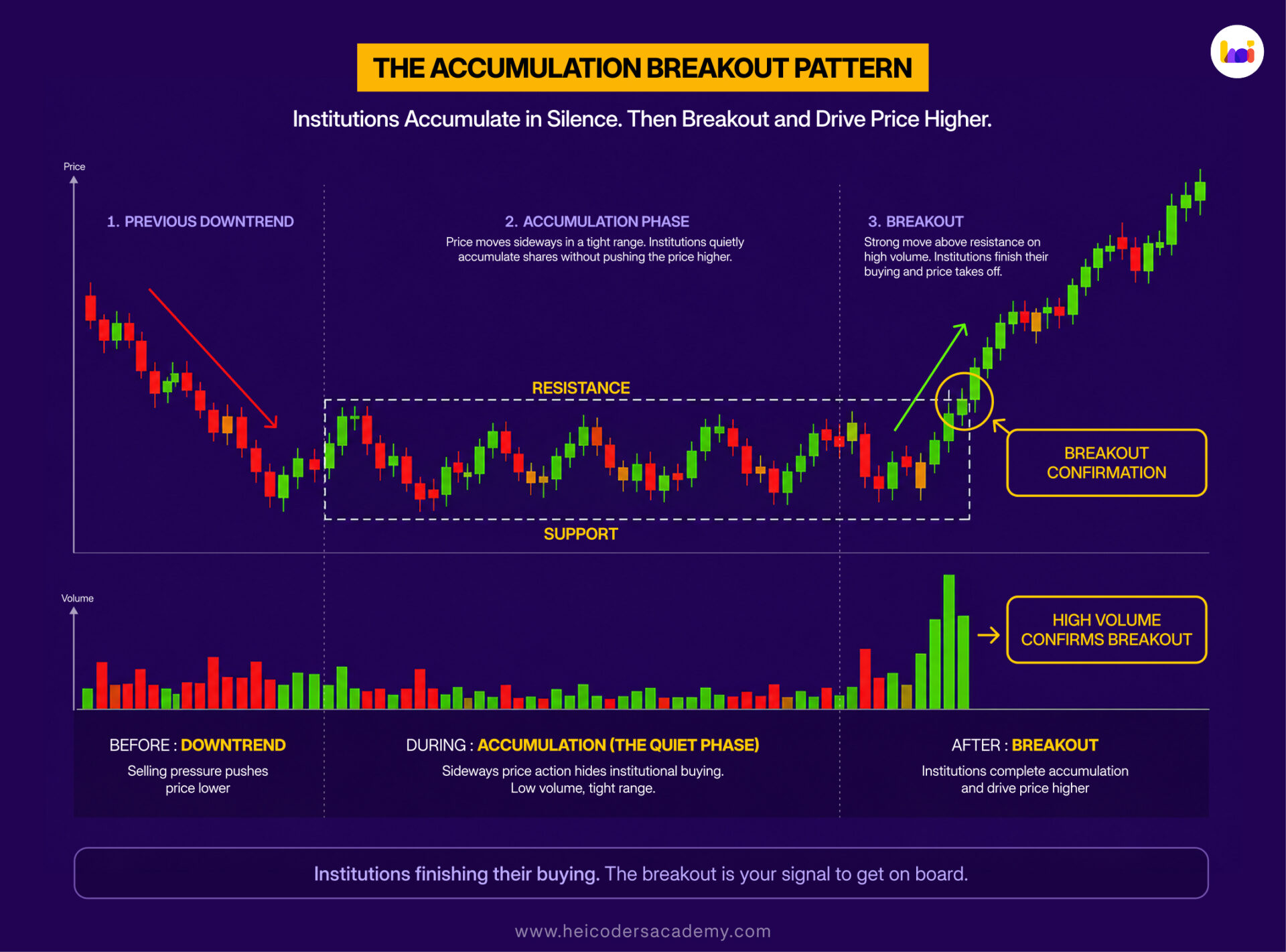
During accumulation, price typically moves sideways within a defined range. To most retail traders, this looks like a boring, directionless stock. Nothing seems to be happening. But underneath the surface, large buyers are quietly absorbing available supply at prices they consider attractive.
This is deliberate. Institutions need the price to stay relatively stable while they build their position. If the price starts running before they have finished accumulating, they end up paying more for the shares they still need to buy. So they work to keep the market calm, absorbing selling pressure without letting price move significantly higher.
The accumulation phase typically ends with a breakout: a sharp, high-volume move above the upper boundary of the trading range. This breakout signals that institutions have finished accumulating and are now letting price rise. Retail traders who recognised the accumulation pattern earlier can position themselves before this move happens.
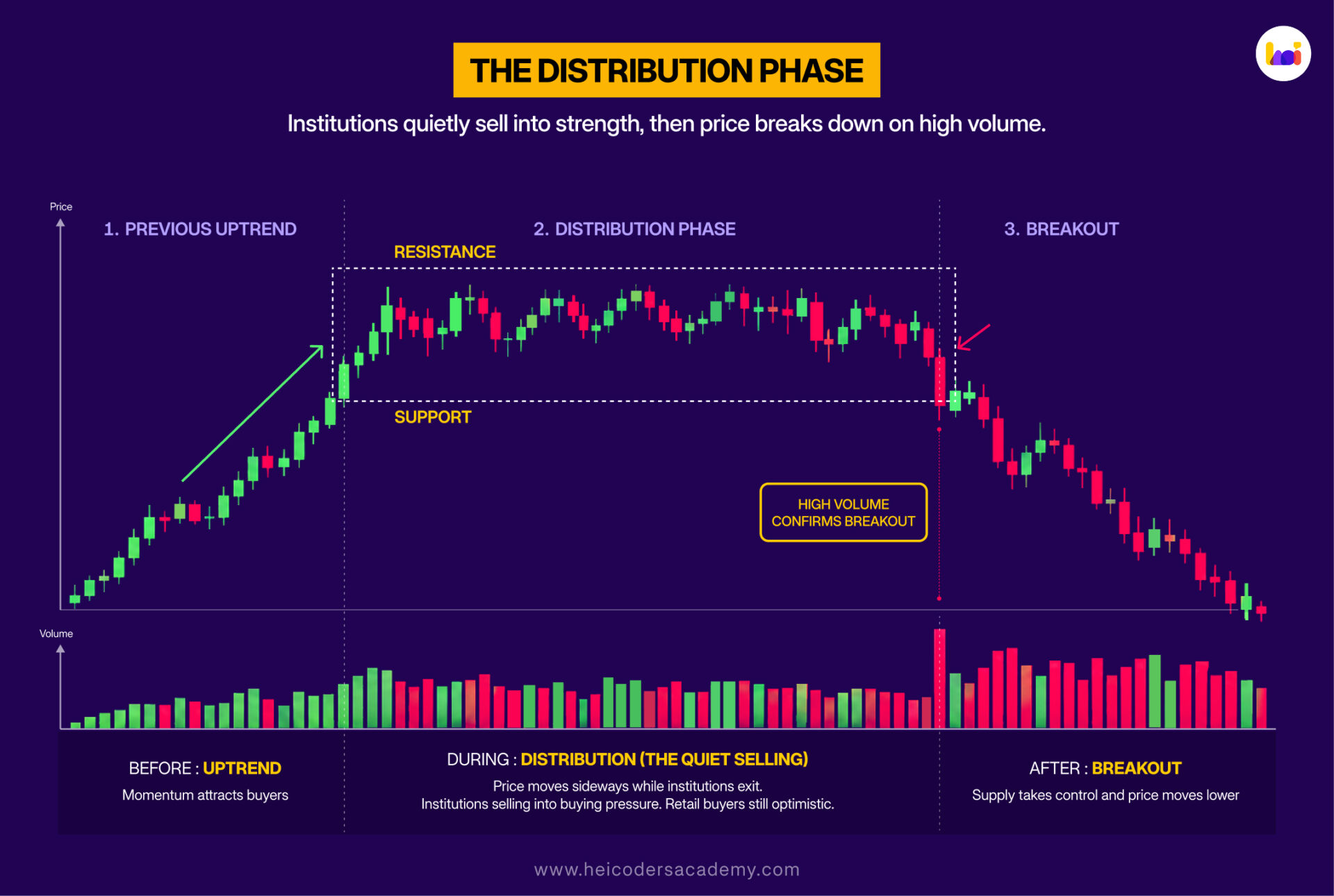
The mirror image of this process is distribution, which occurs when institutions want to exit large positions. Price moves sideways again, but this time institutions are quietly selling into buying pressure from retail traders. Distribution typically ends with a sharp breakdown below the lower boundary of the range.
Stop Hunts: When Institutions Use Retail Traders Against Themselves
One of the more uncomfortable truths about market microstructure is that institutional traders are sometimes aware of where retail stop-losses are clustered, and they use that knowledge deliberately.
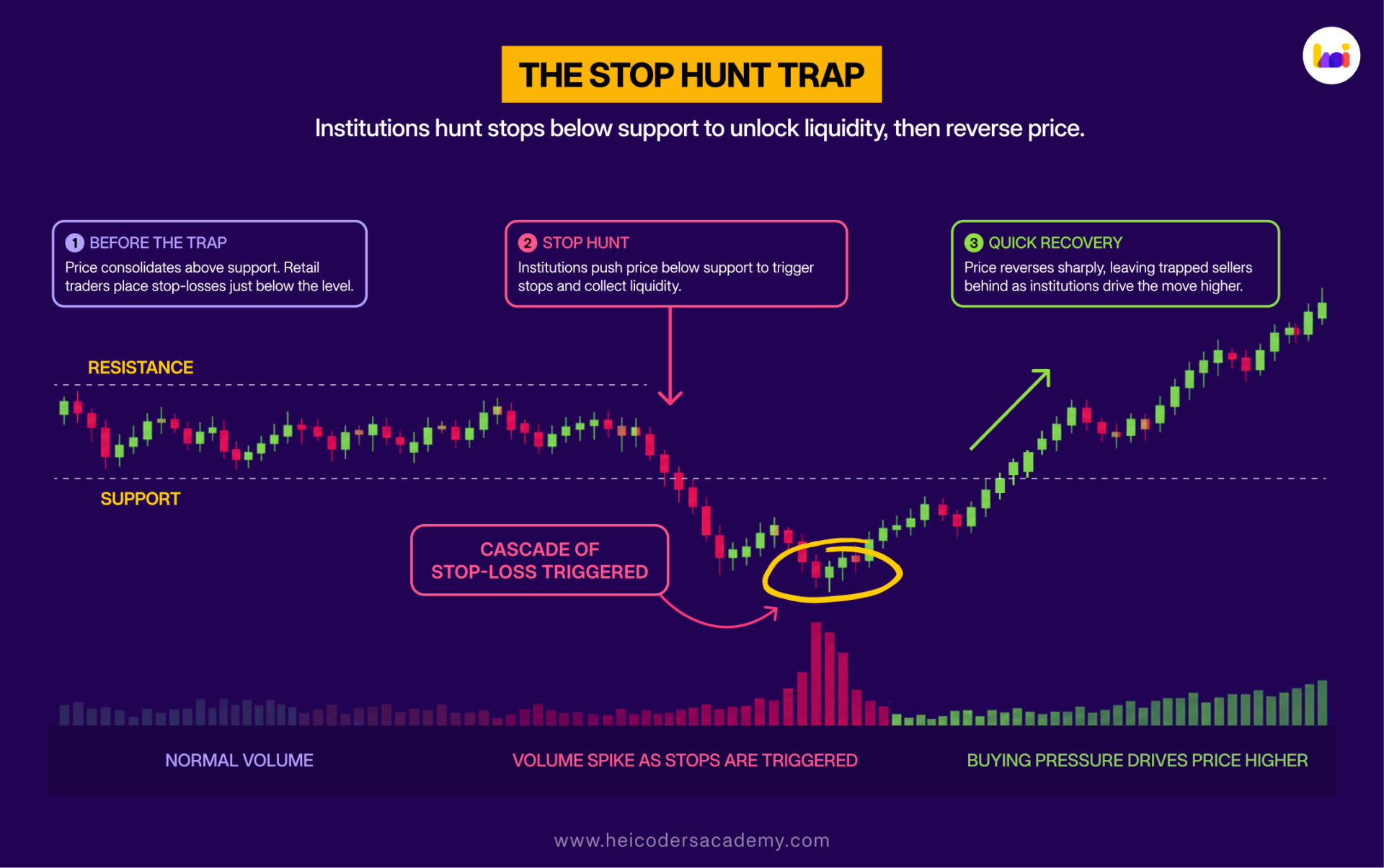
Here is how it works. Most retail traders place their stop-losses just below obvious support levels or just above obvious resistance levels. These are logical placements, and because so many traders follow the same logic, stop-loss orders tend to cluster in predictable locations.
Institutions know this. A brief, sharp move below a widely watched support level will trigger a cascade of retail stop-losses. Those stop-loss orders become sell orders, which temporarily increase the supply of shares available at that price. A large institutional buyer can use that sudden increase in supply to accumulate shares at a discount before price quickly recovers.
This is colloquially known as a stop hunt, and it is one of the reasons why price often dips just below a key support level before bouncing sharply higher. What looks like a breakdown to most retail traders is actually an institutional accumulation opportunity.
Recognising stop hunts is a meaningful edge. When you see price briefly spike below a significant support level on relatively high volume, and then quickly recover and close back above that level, you are often looking at an institution taking advantage of clustered retail stop-losses. That recovery move can be a high-probability entry signal.
How to Read Institutional Footprints in Price and Volume
Institutions cannot completely disguise their activity. Here are the key signals that reveal their presence in a chart.
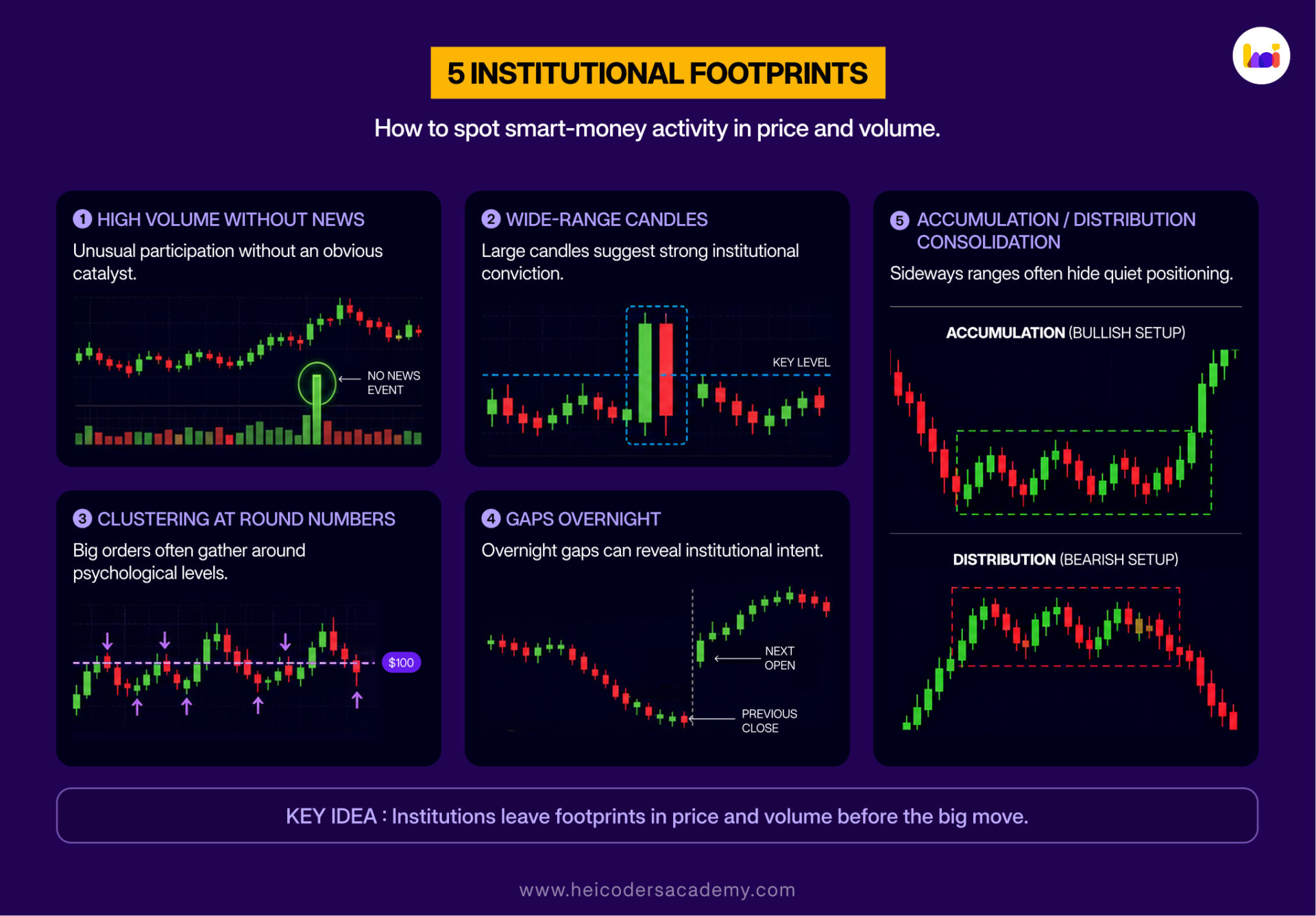
Unusually High Volume Without a Clear News Catalyst
When a stock sees a significant spike in volume without any obvious news to explain it, it is worth paying attention. Volume represents the number of shares changing hands. A sudden surge means that a large number of shares are being bought or sold by someone. When that someone cannot be explained by retail activity alone, institutions are the likely explanation.
High-volume sessions that occur during price consolidation phases (where price is moving sideways) are particularly significant. They often signal institutional accumulation or distribution happening beneath the surface.
Wide-Range Candles at Key Levels
When price reaches a significant support or resistance level and produces a wide-range candle (one with a large body relative to recent candles) on elevated volume, it signals strong institutional conviction at that level. A large bullish candle at support, on heavy volume, suggests institutions are stepping in aggressively as buyers. The opposite applies at resistance.
Price Respecting Round Numbers and Psychological Levels
Institutions frequently place large orders at round numbers (e.g. $50, $100, $200) and other psychologically significant price levels. These levels attract concentrated institutional order flow, which is why price so often stalls, reverses, or consolidates around them. Retail traders who track these levels gain a meaningful context for where institutional activity is likely to be concentrated.
The GAP Strategy: Reading Institutional Intentions Overnight
One of the most revealing institutional signals occurs through price gaps. A gap forms when a stock opens significantly higher or lower than its previous closing price, creating a visible gap on the chart.
Gaps often occur because institutional traders place large orders outside regular market hours, reacting to earnings reports, economic data, or geopolitical developments. A gap up on high opening volume can signal strong institutional buying interest. A gap down can signal institutional selling or exit.
Understanding gaps and how price tends to behave after them (including the common tendency for price to “fill” gaps by retracing back to the pre-gap level) is one of the more practical institutional strategies retail traders can apply directly to their own trading.
Accumulation and Distribution Patterns
As described earlier, sideways price consolidation following a significant trend is one of the clearest signs of institutional activity. The longer and tighter the consolidation, and the lower the volatility within the range, the more likely it is that organised accumulation or distribution is taking place.
When the eventual breakout or breakdown occurs, the accompanying volume is the key confirmation signal. A breakout on high volume is much more significant than one on thin volume, because it suggests large players are driving the move rather than a small number of retail participants.
Practical Ways Retail Traders Can Position Alongside Institutions
Understanding institutional behaviour is only useful if you can translate it into better trading decisions. Here are the core applications.
Trade in the direction of the institutional trend, not against it. The biggest, most sustained price moves happen when institutions are committed to a direction. Trying to short a stock that institutions are accumulating is one of the most expensive mistakes a retail trader can make. Identifying the institutional trend and aligning with it improves your win rate substantially.
Wait for the breakout confirmation before entering. It is tempting to try to buy during the accumulation phase before the breakout happens. But breakouts without volume confirmation fail frequently. Waiting for a high-volume breakout above the accumulation range is a more reliable entry signal, even if it means missing the absolute lowest entry price.
Use volume as your primary confirmation tool. Price action tells you what is happening. Volume tells you whether the big players are behind it. A price signal without volume confirmation is a much weaker trade setup than one where both price action and volume align.
Pay close attention to behaviour at key levels. Watch how price reacts when it hits a significant support or resistance level. A clean rejection on high volume tells a clear story about institutional conviction at that level. A messy, low-volume reaction is less informative and carries less conviction.
Learn to recognise stop hunts as entry opportunities. When price briefly dips below a well-known support level on high volume and then recovers quickly, consider whether you are looking at a stop hunt rather than a genuine breakdown. If the recovery is strong and volume was elevated on the dip, there is a reasonable case that institutions were absorbing retail stop-loss selling at that level.
Why Most Retail Traders Never Learn This
The information in this guide is not secret. The concepts of institutional trading, accumulation and distribution, stop hunts, and volume analysis are well-documented in professional trading literature.
The reason most retail traders never apply them is not a lack of access to information. It is a lack of structured learning that connects these concepts to practical, real-world chart reading.
Most beginner trading content focuses on simple indicators and basic chart patterns in isolation, without explaining the institutional context that makes those patterns significant. You can memorise every candlestick pattern in existence and still struggle if you do not understand why those patterns form, which comes back to institutional order flow.
Traders who understand the institutional landscape make better decisions at every stage: they read consolidation differently, they interpret volume more accurately, and they approach key price levels with a clearer sense of what to expect.
Frequently Asked Questions About Institutional Trading
What is the difference between institutional and retail traders? Institutional traders are organisations (hedge funds, banks, pension funds) that trade with very large amounts of capital on behalf of their clients or themselves. Retail traders are individuals trading their own personal capital. The key difference is scale, and scale changes both the strategies available and the market impact of any given trade.
Can retail traders really trade alongside institutions? Yes, by learning to read the footprints institutions leave in price and volume data. Retail traders cannot match institutional resources, but they can observe institutional behaviour and make more informed decisions based on it.
What is smart money in trading? “Smart money” is a colloquial term for institutional traders and other well-capitalised, sophisticated market participants. The idea is that these participants tend to be better informed and better resourced than the average retail trader, so tracking their activity can provide useful signals.
What is a stop hunt in trading? A stop hunt occurs when price briefly moves to a level where retail stop-loss orders are clustered, triggering those orders before reversing. Institutions sometimes engineer these moves to accumulate shares at more favourable prices using the selling pressure created by triggered stop-losses.
How can I tell if volume is institutional? There is no definitive way to attribute volume to a specific type of trader. However, unusually high volume without an obvious news catalyst, particularly during periods of price consolidation or at key technical levels, is often a signal of institutional activity.
What is the accumulation and distribution theory? Accumulation refers to the phase when institutional traders are quietly building large long positions, typically during sideways price consolidation. Distribution refers to the phase when they are exiting those positions, also typically during sideways consolidation. Both phases tend to precede significant directional price moves.
Does technical analysis help identify institutional activity? Yes. Volume analysis, candlestick patterns, support and resistance levels, and price action around key areas all help identify the fingerprints of institutional order flow. Technical analysis is one of the most accessible tools retail traders have for understanding what large players are doing.
Learn to Read the Market the Way Professionals Do
Most retail traders spend their time reacting to price movements that were set in motion long before they noticed them. Learning to read institutional behaviour is what shifts you from being reactive to being positioned.
At Heicoders Academy, the Profitable Stock Trading Course with Technical Analysis (PSTTA) goes beyond the basics of chart reading to teach you the institutional playbook: how hedge funds and large institutions trade, how their order flow creates the patterns you see on every chart, and how to use that understanding to find higher-probability setups.


You will learn directly from Gibson Low, a hedge fund director and former family office portfolio manager who has spent over a decade managing eight-figure portfolios for ultra-high-net-worth clients. He brings the institutional perspective into every lesson, not as theory, but as the practical framework he has used in real markets.
“I do not teach people how to chase stocks. I teach them how to read behaviour, manage risk, and wait for the moment that matters.”
The course is IBF-accredited and eligible for up to 70% subsidy for eligible Singapore residents.
👉 Explore the PSTTA course and see upcoming schedules.
*Disclaimer: The content discussed is intended for information and educational purposes only and should not be considered investment advice or recommendation. The value of your investments may go up or down. Your capital is at risk. This advertisement has not been reviewed by the Monetary Authority of Singapore.*
Disclaimer: The content discussed is intended for information and educational purposes only and should not be considered investment advice or recommendation. The value of your investments may go up or down. Your capital is at risk. This advertisement has not been reviewed by the Monetary Authority of Singapore.